

The Subcommittee on Plant Health Diagnostics (SPHD) is committed to helping facilitate the progression of laboratory accreditation and proficiency testing.
Benefits
Laboratories taking part in regular proficiency testing provide regulatory bodies with confidence in the results of diagnostic tests, which is vital when dealing with international or interstate trade issues.
Other significant benefits to laboratories include:
- Confirming competent performance
- Evidence of proficiency for accreditation
- Identifying testing or measurement problems
- Comparing methods or procedures
- Comparing operator capabilities
- Educating staff
- Instilling confidence in staff and management
- Strengthening networks between laboratories
- Providing laboratories with additional risk management.
SPHD works collaboratively with participating laboratories to improve diagnostic services and continues to refine the proficiency testing program to ensure maximum benefits to participants.
National Plant Health Proficiency Testing Program details
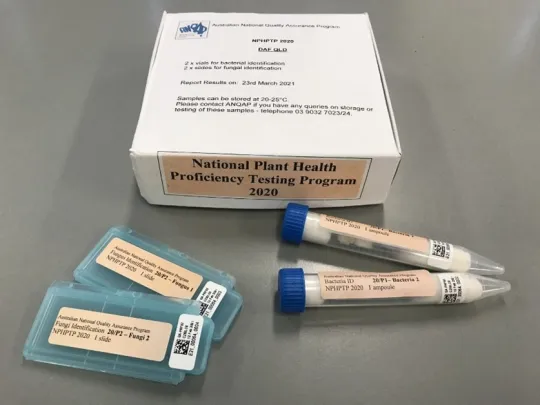
SPHD has delivered the National Plant Health Proficiency Testing Program (NPHPTP) since 2012. The Proficiency Testing Coordinator, appointed by SPHD, manages the delivery of the program.
The NPHPTP determines the testing performance of participating laboratories against pre-established criteria by means of confidential, interlaboratory comparison. Each year, one or more species from the specimen groups are included in the program.
The specimen groups are:
- Insects and mites
- Nematodes
- Fungi
- Bacteria
- Viruses
- Phytoplasma
- Bioinformatics
Each jurisdiction is responsible for the provision of the panels, and this is done on a rotational basis that is determined in advance. Samples can be collected from field surveys, reference collections, or samples submitted for diagnostics. It is a requirement that the specimens used for the panels are verified through sequencing and that they have been vouchered within a collection. The Proficiency Testing Coordinator is responsible for checking that all specimens meet the biosecurity rules and regulations for each jurisdiction.
Each year, Australian and New Zealand laboratories in the National Plant Biosecurity Diagnostic Network can elect to receive specimens from all specimen groups or just the groups relevant to the expertise in the laboratory. Background information about the samples, such as the host, part of host plant affected, symptoms, extent of damage and collection region is provided with the samples. The laboratories are asked to identify the samples and provide feedback on the process.
Results are collated and sent back to the participating laboratories, with each laboratory de-identified. After all laboratories have received their results, feedback sessions on each of the panels is set up by the Proficiency Testing Coordinator. Everyone is encouraged to participate and discuss how they did their identifications. The system has been redesigned to encourage learning and development between the laboratories and improve greater collaboration between the jurisdictional teams.
Resources
Guides are available to inform laboratories on both collection and supply of specimens and acceptable taxonomy.
Program funding
Funding for the delivery of the program is provided by the Department of Agriculture, Water and the Environment to source specimens to use in the program. Fees apply for participation in the program which is currently only available to Australian and New Zealand participants.
Get your laboratory involved
Contact us if you would like more information about the program or to become involved.